.png)
By Sarah Dalby, Head of Key Stage 4
What can a 1,200-year-old tree teach us about how children learn?
Quite a lot, as it turns out.
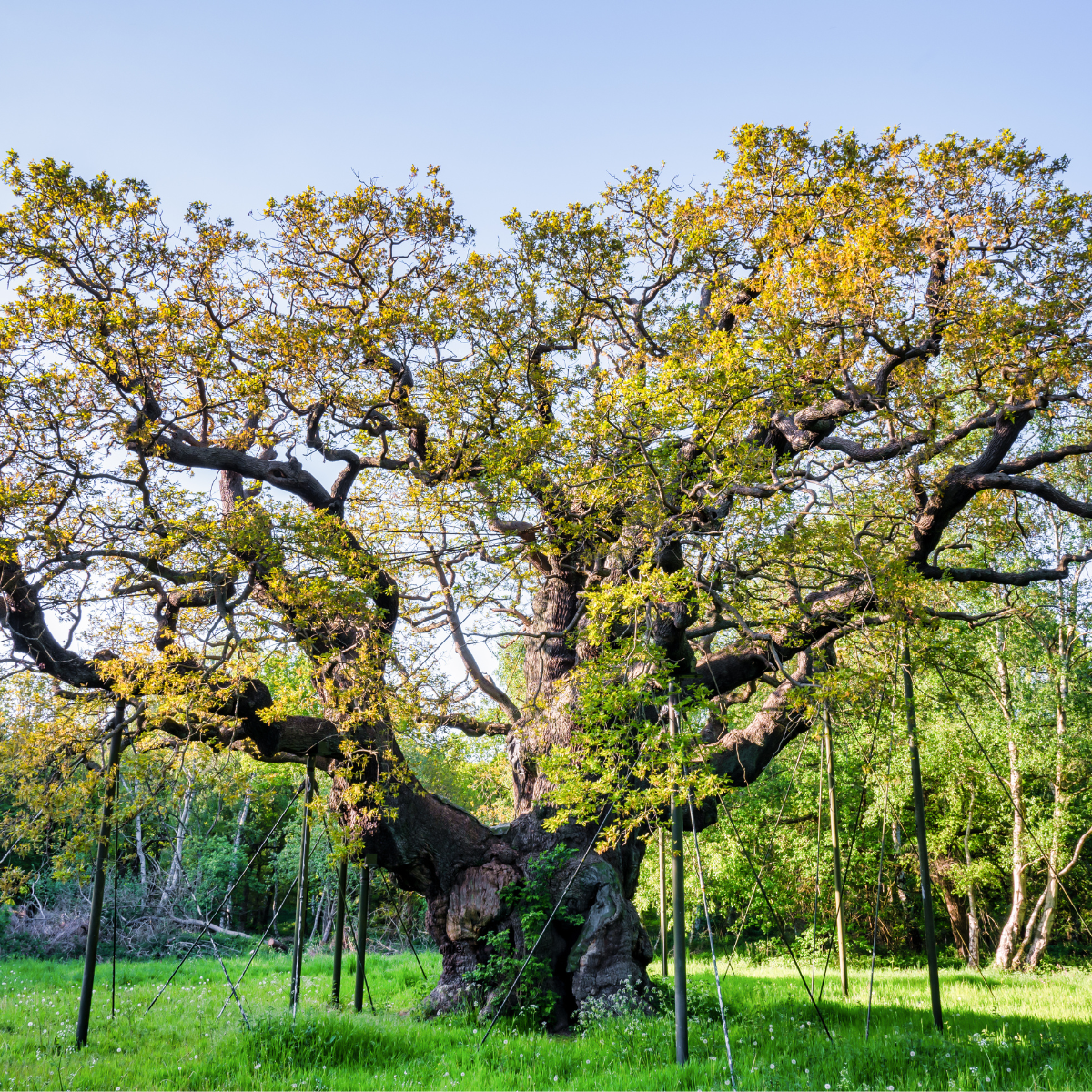
Worksop College sits in more than 330 acres of grounds and woodland, just a few miles from the ancient woodland of Sherwood Forest. So, when the Major Oak made headlines this summer following its death after around 1,200 years, it seemed like an appropriate starting point for thinking about teaching and learning.
What you may not know is that if the Major Oak had been a lone tree, rather than part of a forest, it may not have lived for as long - possibly only around 600 years.
Why is that? Why might a tree live for twice as long in a forest?
There are many reasons, including the microclimate that a forest creates, but another fascinating reason is that trees talk!
Yes, you heard me correctly - trees talk to each other.
Underground, there is a network of fungi surrounding a tree’s roots, known as mycorrhizae. Trees can communicate with each other through this underground network and, in doing so, help one another. Trees look after each other.
When a tree is suffering, other trees can redirect resources through this underground network to help it. If a predator arrives and begins feeding on a tree’s leaves, trees can signal to one another, prompting them to release chemicals that either change the taste of their leaves or attract the predators of the pests.
Trees in a forest therefore challenge the evolutionary idea of ‘survival of the fittest’. Instead, they work together as a superorganism, helping to keep one another alive.
Perhaps the most interesting thing about a forest is that its strength doesn’t come from each tree standing alone. It comes from the connections between them.
Learning can work in much the same way. When pupils begin to make connections between different pieces of knowledge, topics and experiences, they become better equipped to use what they know in new situations.
And this brings us back to the classroom.
Knowing something isn't always the same as knowing how to use it.
A few years ago, I asked one of my tutees a question that puzzled me. She had consistently performed well in her end-of-topic Maths tests throughout the year, but was disappointed with the result she received in her mock examination. Why?
Her answer was incredibly revealing:
“When I do an end of topic test, I know what the question is about and therefore know the method, but when they mix the questions up, I can’t work out which question is about which topic and therefore don’t know which method to pick.”
She knew the knowledge. What she found difficult was recognising when and how to apply it. This is something we see in many subjects. A pupil may be able to recall a fact, explain a concept or successfully complete a familiar type of task, but what happens when the context changes?
Perhaps the question is worded differently. Perhaps information from several topics is brought together. Perhaps the question involves something the pupil has never encountered before. It is at this point that learning has to become more than remembering.
Helping pupils to ‘unlock the question’
This is the idea behind transfer of learning. Transfer of learning is the ability to take knowledge, understanding or a skill that has been developed in one context and apply it successfully in another. It is an important part of becoming an independent learner.
In Biology, for example, pupils might learn about the role of mycorrhizae in helping plants absorb water and inorganic ions. But an examination question might present that knowledge through an unfamiliar scenario involving trees, giraffes, crops or plant communication.
The pupil therefore has to do more than recall the lesson.
They have to ask:
- What do I already know?
- What is this question really asking me?
- Have I encountered a similar problem before?
- What strategies do I already know that might help me here?
- How can I apply what I know to this new context?
These are the skills that allow pupils to ‘unlock the question’ and, importantly, to hold their nerve when the context is unfamiliar.
From ‘What did I do?’ to ‘What did I learn?’
At Worksop College, we are encouraging teachers to make these connections explicit. This means thinking carefully about what we want pupils to learn, rather than simply what we want them to do in a lesson. It also means giving pupils opportunities to apply their knowledge in different contexts and encouraging them to reflect on the strategies they have used.
We are developing this through metacognition - helping pupils to think about their own thinking and become more conscious of how they learn.
Three simple questions can be particularly powerful:
- What did I learn today? Not: what did I do?
- What did I learn that I could apply to a different question or topic?
- What did I learn that I could apply to a different subject?
The aim is to help pupils build connections between pieces of knowledge rather than seeing every lesson as an isolated unit.
Why unfamiliar questions matter
It can be tempting to think that a difficult question is one where a pupil doesn't know the answer. Sometimes, however, the real difficulty is that the pupil doesn't recognise what they already know that could help them answer it. This is why unfamiliar contexts can be so valuable.
A Biology question about giraffes moving between acacia trees, for example, may initially appear to have little connection to a lesson about plant communication. But once pupils identify the key information, recognise the topic and think about what they already know, the connection begins to emerge.
The same principle applies across subjects. A pupil might use a method first encountered in Maths to tackle a new problem, apply analytical skills developed in English to a History source, or draw on knowledge from Science when encountering a new geographical problem.
The goal isn't to make every question familiar. It is to make pupils more confident when it isn't.
Learning that travels
Ultimately, education should give pupils knowledge that they can take with them. We want them to remember what they have been taught, but also to recognise where that knowledge might be useful next. That might be in the next lesson, a different subject, an examination question they have never seen before, university, their future career or simply a problem they encounter in everyday life.
And perhaps this is where the trees provide such an interesting analogy.
A forest is stronger because its individual trees don't exist entirely alone. They are part of a wider, interconnected system.
Learning can work in a similar way.
The more connections pupils make between ideas, subjects, experiences and strategies, the more robust their understanding becomes. Our aim at Worksop College is not simply to equip pupils to answer the questions they have practised. It is to help them become the kind of learners who can look at an unfamiliar question, draw on what they already know, make connections and think:
"I haven't seen this before - but I know how to start.”
Three questions to ask at home
Parents can support this approach too. Instead of asking simply “What did you do at school today?”, try asking:
- What did you learn today?
- What did you learn that you could use in a different question or topic?
- What did you learn that you could use in a different subject?
These questions encourage children to think beyond the individual lesson and start making connections between what they know.
And those connections are where learning becomes truly transferable.
To find out more about the amazing life of trees and how they communicate with each other I would highly recommend this book: The Hidden Life of Trees by Peter Wohlleben


Head of Key Stage 4
Sarah has taught for 22 years and has taught Biology at Worksop College for 14 years. She holds a degree in Pharmacology and a PGCE from the University of Sheffield and was awarded Advanced Skills Teacher status in 2008 for classroom excellence.